
Fields Across Chase County Property Tax Records
Value and collection sit in separate offices. Chase County publishes no online parcel-level bill search, so a useful checklist separates what to request from each custodian of the property records.
| Field | What It Shows | Where |
|---|---|---|
| Market value | Appraiser estimate used in assessment. | Appraiser |
| Assessed value | Classification percentage applied to market value. | Appraiser |
| Classification or exemption | Status that may alter the taxable base. | Appraiser |
| Tax and special assessments | Amount billed for the stated year. | Treasurer |
| Payment or delinquency | Whether the account is paid, due, or delinquent. | Treasurer |
Most Kansas residential real estate is assessed at 11.5 percent of fair market value, while agricultural-use land and other classifications follow different rules. An assessed value is not a sale price. A bill is not an appraisal.
Chase County Splits Value from Collection
Two offices divide the work in Chase County. The Chase County Appraiser, Andrew Durbin RMA, sets values on every parcel each year. His office can walk you through classification, land and improvement values, exemptions, and any sales data it maintains. His staff also fields questions about any sales data. Reach the appraiser at 620-273-6306 or appraisersoffice@gmail.com.
Billing works differently. Treasurer Bernice Albers handles tax bills, collections, delinquencies, special assessments, and county funds. Her office takes calls at 620-273-6493. The treasurer's counter is open 8:00 to 4:30. It asks visitors to arrive by 4:15, and it keeps a drop box on the courthouse's southeast side. Chase County publishes no online parcel bill lookup. Payment questions go through the office itself.
Follow a Chase County Tax Bill to Its Receipt
Prepare the address, owner name, legal description or parcel number, and the exact tax year before requesting a Chase County tax bill. A current name may not retrieve an older bill.
- Ask the Appraiser to identify the parcel and provide annual roll fields.
- Give that parcel identity and tax year to the Treasurer.
- Ask for original tax, special assessments, payment dates, balance, and delinquency status.
- Request an existing bill, statement, or receipt and ask whether certification is offered.
- Assessed value
- The class percentage applied to market value.
- Mill levy
- Tax measured per $1,000 of assessed value.
- Homestead refund
- Kansas relief for qualifying households; the Clerk offers filing help.
- Tax lien
- A claim arising from unpaid property tax.
Kansas Dates Govern Chase County Property Tax
The Kansas tax calendar sets the pace. Real-property notices are issued by March 1, and an equalization appeal begins within 30 days. Appraisers certify values by June 1. Taxing subdivisions certify budgets by August 25. Rolls reach county clerks by November 1, statements follow by December 15, one-half is due December 20, and the second half falls due May 10. Payment under protest is a separate route when taxes are paid, so verify current filing details with Chase County.
Chase County's 2026 Study Signals Residential Change
The county's annual market study reports a 2 to 10 percent upward residential trend during 2025 for assessment year 2026, with agricultural-use land excluded. Vacant-property direction stayed unclear. Commercial and industrial results were mixed.
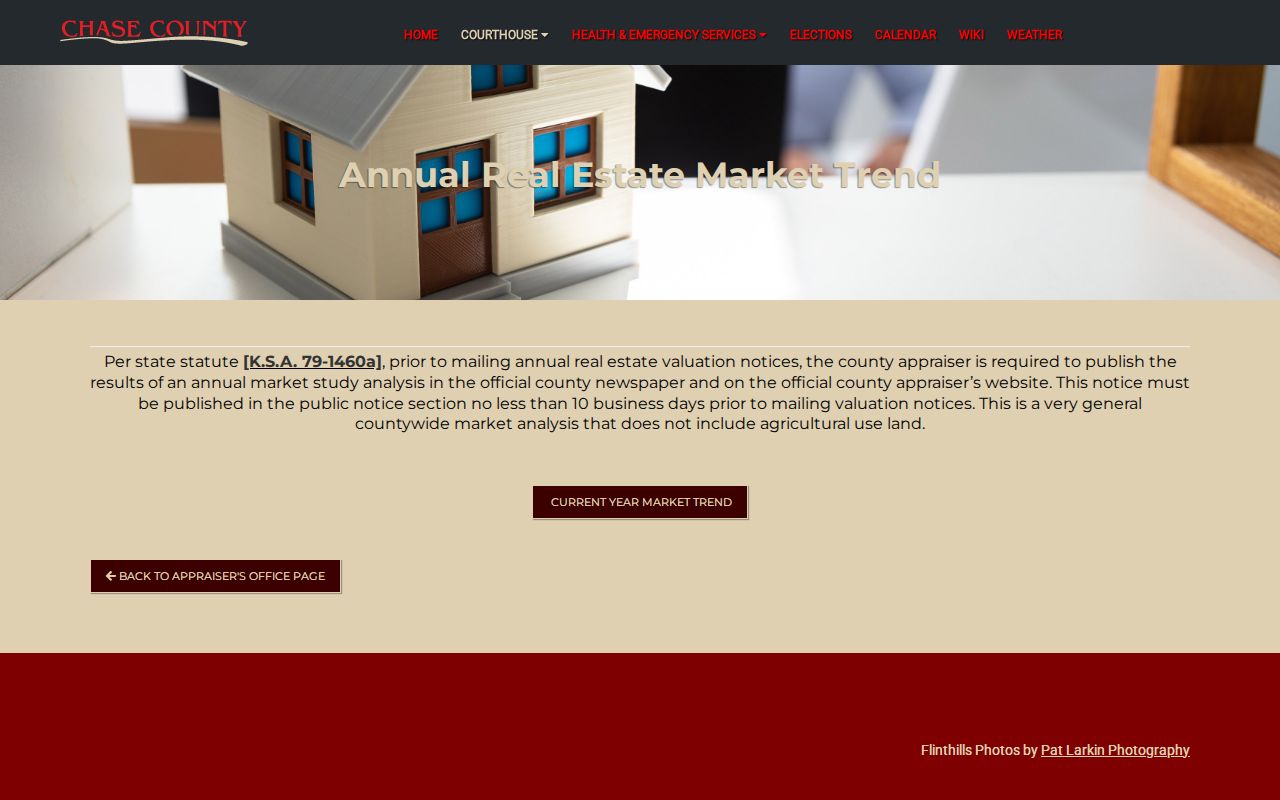
The countywide study explains a changing notice. It cannot set a parcel value or a city trend, so treat it as context rather than an answer.
The 2025 Chase County Tax Snapshot Is Aggregate
A Kansas Department of Revenue report lists $71,112,912 in taxable value for 2025. Ad valorem tax totaled $10,293,267. Public utilities account for 39.04 percent of the value. They show scale, not account status. Use the Appraiser roll and the Treasurer account for parcel-level answers, since the report cannot replace a bill, a payment receipt, or an assessment notice.
Levy Sheets Connect Chase County Values to Bills
The Appraiser defines a mill as $1 per $1,000 of assessed value. The statewide school levy is 20 mills. That school share is not the total levy. Tax districts and special assessments can make similar parcels produce very different tax bills. The County Clerk's levy sheets run 2019 through 2025. Match the right year and district to the parcel classification and Treasurer statement rather than relying on a county average.
Contest a Chase County Assessment on Time
An owner can request an informal Appraiser meeting within 30 days after the valuation notice. Strong evidence helps. Bring the notice, correct property description, measurements, condition photographs, comparable sales, and classification facts. Kansas offers the Board of Tax Appeals or its small-claims division where disagreement remains. Payment under protest is separate. That route opens when taxes are paid. The two appeals cannot share a property and year, so confirm the route before filing.
Keep valuation apart from payment. The Appraiser handles classification, land and improvement facts, and value evidence. The Treasurer handles the rest. That means payments, balances, special assessments, delinquency, and redemption. A just-recorded deed can precede the annual roll's owner-name update, so compare the deed date with the roll year rather than reading the lag as an error.
A written KORA request needs specifics. Name the parcel, tax year, precise existing record, and preferred copy form. Chase County says a department responds within three business days by producing the record, stating when and how it will be supplied and its cost, or explaining why it cannot. Ask for segregable portions.
Classification deserves a separate check. Residential, agricultural, utility, commercial, industrial, and exempt parcels may receive different treatment, and a refund or exemption is not the same as lower market value. The County Clerk helps with homestead-refund filing. The Appraiser remains the source for assessment facts.
For delinquency, request the tax year, principal, added amounts, payments, special assessments, and current sale or redemption status. A county total proves nothing about a lien. Match the account to the parcel and legal description, then confirm present status with the Treasurer.
Watch the notice date. The Kansas equalization appeal window generally lasts 30 days after the real-property valuation notice.